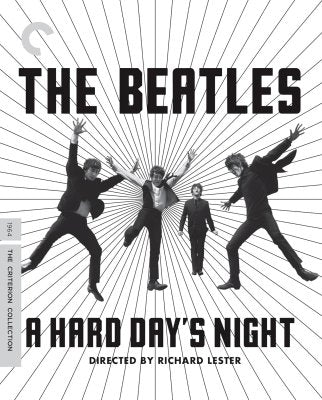
The Beatles - A Hard Days Night Blu-Ray
Meet The Beatles! Just one month after exploding onto the American scene with their appearance on The Ed Sullivan Show, John, Paul, George, and Ringo began work on a project that would bring their revolutionary talent to the big screen. This film, in which the band members play slapstick versions of themselves, captured the astonishing moment when they officially became the unique, irreverent idols of their generation and changed music forever. Directed with loud, all-or-nothing energy by Richard Lester (The Knack . . . and How to Get It) and featuring a string of iconic pop anthems—including the title track, "Can't Buy Me Love," "I Should Have Known Better," and "If I Fell" – A Hard Day's Night, which redefined film music and had an enormous influence on music videos, is one of the most entertaining films of all time.
DIRECTOR'S APPROVED BLU-RAY SPECIAL EDITION CONTENTS
4K digital restoration, approved by director Richard Lester, with three audio options – a mono soundtrack and stereo and 5.1 surround mixes supervised by sound engineer Giles Martin at Abbey Road Studios – presented in uncompressed mono, uncompressed stereo, and DTS-HD Master Audio
Audio commentary with cast and crew
In Their Own Voices, a program combining interviews with The Beatles from 1964 with behind-the-scenes footage and photos
”You Can't Do That: The Making of "A Hard Day's Night," a 1994 documentary by producer Walter Shenson, including an outtake performance by the Beatles. Things They Said Today, a 2002 documentary about the film with Lester, music producer George Martin, screenwriter Alun Owen, and cinematographer Gilbert Taylor. Picturewise, a program about Lester's early work, featuring an audio interview with the director from 2014. The Running Jumping & Standing Still Film (1960), Lester's Oscar-nominated short film
Anatomy of a Style, a 2014 program about Lester's methods
2014 interview with Beatles biographer Mark Lewisohn
English subtitles for the deaf and hard of hearing
PLUS: An essay by critic Howard Hampton
Choose options